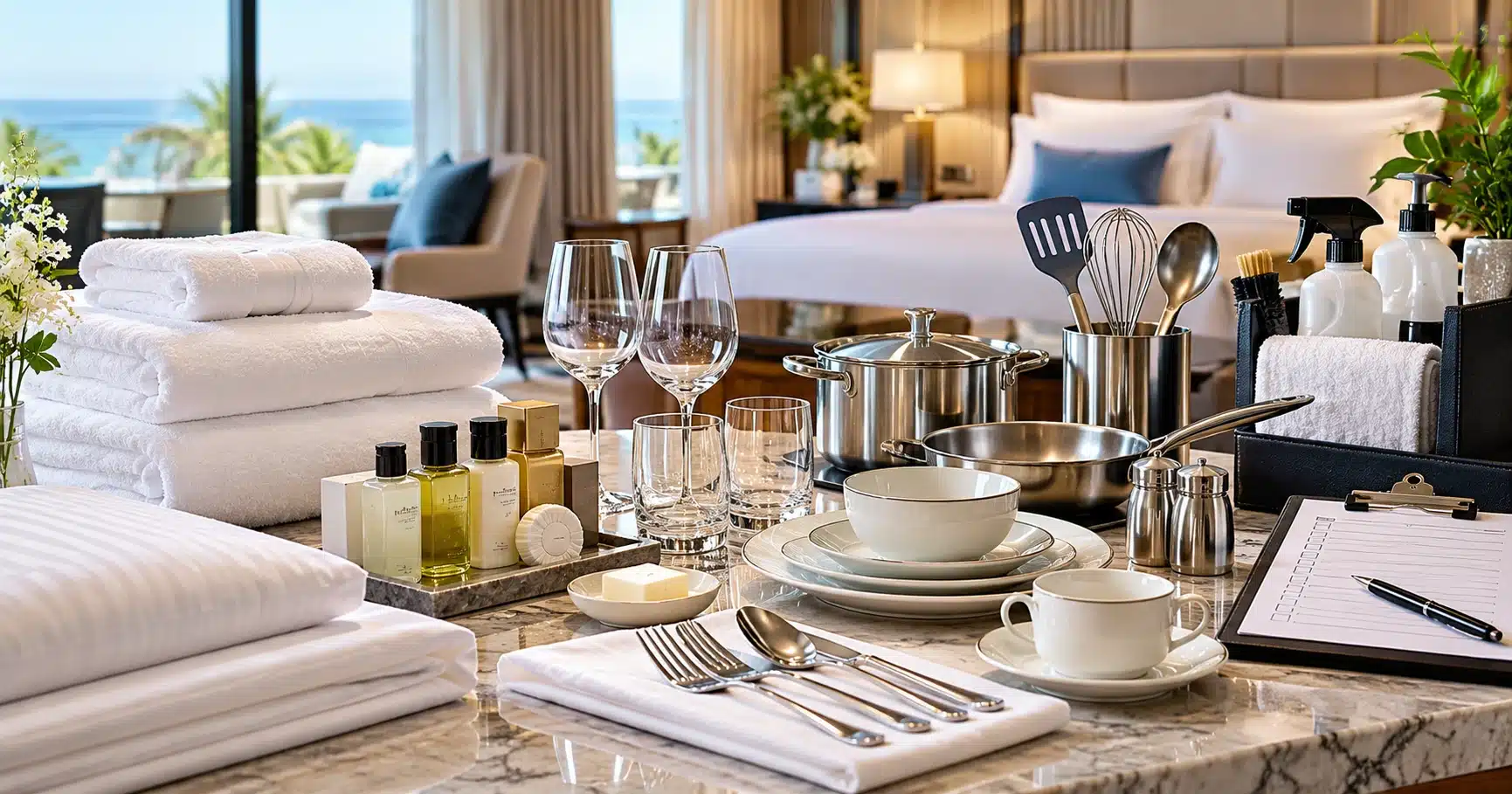
Hotel operating supplies and equipment (OS&E) include the everyday supplies and reusable items hotels need to serve guests and maintain daily operations. These include guestroom amenities, linens, housekeeping supplies, kitchen utensils, and food and beverage equipment.
Effective OS&E management involves identifying departmental requirements, distinguishing OS&E from FF&E, planning procurement, estimating budgets, selecting suppliers, and maintaining inventory. Hotel owners and procurement teams must also consider product quality, purchasing costs, replacement cycles, and stock replenishment to prevent shortages, control expenses, and maintain consistent guest service.
What Are Hotel Operating Supplies and Equipment (OS&E)?
Hotels classify OS&E based on how items are used, how frequently they need replacement, and which departments require them. Unlike long-term furnishings and fixtures, many operating supplies are consumed, cleaned, reused, or replaced regularly.
Clear classification helps procurement teams determine purchasing quantities, assign budgets, and maintain accurate inventory records.
What Is Included in Hotel OS&E?
Hotel supplies and equipment generally fall into three categories:
- Consumables: Toiletries, cleaning chemicals, stationery, and disposable amenities.
- Reusable supplies: Hotel linen and towels, glassware, cutlery, and staff uniforms.
- Operating equipment: Housekeeping carts, kitchen utensils, luggage trolleys, and selected maintenance tools.
The exact classification depends on hotel accounting policies and purchasing specifications.
Why OS&E Matters for Hotel Operations and Guest Experience
Reliable supplies keep rooms ready, restaurants functional, and services consistent. Missing towels, damaged tableware, or inadequate cleaning equipment can interrupt hotel operations and reduce guest satisfaction.
Effective hotel supply management also improves operational efficiency by preventing emergency purchases and unnecessary inventory.
OS&E vs. FF&E: What Is the Difference?
The main distinction between OS&E vs. FF&E is how items are used and replaced. OS&E supports recurring service activities, while furniture, fixtures, and equipment (FF&E) generally includes longer-lasting items used to furnish and equip a property.
Key Differences Between OS&E and FF&E
Operating supplies vs. fixed assets is an important distinction for budgeting and accounting. Major hotel FF&E purchases are commonly treated as capital expenditure (CapEx), while consumable OS&E often forms part of operating expenditure (OpEx).
However, individual equipment classifications depend on capitalization policies, useful life, and applicable accounting standards.
Common Examples of OS&E and FF&E in Hotels
OS&E includes towels, toiletries, serving utensils, and cleaning materials. FF&E commonly includes beds, sofas, desks, and substantial movable equipment.
Some hotel furniture accessories, such as small decorative items, require project-specific classification. Clear FF&E specification software documentation helps teams maintain consistent records.
Summarized Comparison Table: OS&E vs. FF&E
| Category | OS&E | FF&E |
| Purpose | Daily service | Furnishing and infrastructure |
| Examples | Towels, amenities, utensils | Beds, sofas, desks |
| Replacement | Frequent or periodic | Generally longer-term |
| Budget | Operating or opening expense | Often capital investment |
| Management | Purchasing and operations | Design, assets, and procurement |
FF&E and OS&E coordination ensures that hotel rooms receive both permanent furnishings and the supplies needed for operation.
Complete Hotel OS&E List by Department
A comprehensive hotel OS&E list should identify department-specific products, required quantities, specifications, and replacement needs. This reduces missed purchases during hotel pre-opening and supports ongoing service delivery.
Guestroom Supplies and Guest Amenities
Guest room supplies include products guests use throughout their stay:
- Hotel linen and towels
- Bedding and pillows, where classified as operating inventory
- Bathroom amenities and toiletries
- Hangers, tissue boxes, and waste bins
- Guest stationery and disposable products
Luxury hotel supplies may emphasize premium materials, while extended-stay hotel supplies often reflect longer guest stays.
Housekeeping and Laundry Supplies
Essential housekeeping supplies include cleaning chemicals, microfiber cloths, brushes, and waste bags.
Laundry equipment and supplies may include detergents, linen carts, and handling accessories. Larger machines are frequently classified separately from consumables.
Food and Beverage Operating Supplies
Food and beverage equipment supports restaurant, bar, banquet, and room-service operations.
Typical items include tableware and dinnerware, glassware and cutlery, trays, serving tools, and reusable containers. Quantities depend on seating capacity, turnover, and service style.
Kitchen Supplies and Small Equipment
Kitchen utensils and cookware include pots, pans, knives, preparation containers, measuring tools, and serving accessories.
Commercial-grade equipment should satisfy operational workloads, hygiene standards, and applicable health and safety requirements.
Front Office and Guest Services Supplies
Front desk equipment may include small operational devices, organizers, and communication accessories. Reception supplies include registration materials, key-card holders, and hotel stationery and office supplies.
Guest service equipment may include luggage carts and portable assistance tools, depending on asset classification.
Spa, Fitness, and Recreational Supplies
Pool, spa, and leisure supplies include pool towels, treatment consumables, sanitizing products, and recreational accessories.
Back-of-house supplies also cover maintenance tools and supplies, safety and security equipment, and staff support materials.
How the Hotel OS&E Procurement Lifecycle Works
The OS&E procurement process follows five stages: requirement planning, specification, supplier sourcing, delivery, and replenishment. This structured approach helps hotels control purchasing decisions from development through daily operation.
Step 1: Identify OS&E Requirements for Each Department
Procurement planning begins with room counts, facilities, service levels, and department requirements.
A limited-service hotel generally needs fewer operating categories than a full-service hotel. Boutique hotel equipment and resort operating supplies may require additional specialized products.
Step 2: Develop Product Specifications and Purchasing Budgets
Each item needs documented product specifications, quantities, approved materials, and expected costs.
A centralized design specification software workflow can help teams maintain organized product details, vendor information, and approvals.
Step 3: Evaluate Suppliers and Place Purchase Orders
Hotel supply sourcing requires supplier quotations, quality comparisons, and delivery commitments.
Supplier selection should consider pricing, availability, supplier lead times, warranties, and reliability before issuing purchase orders.
Step 4: Coordinate Delivery, Storage, and Inventory Tracking
Successful delivery scheduling accounts for storage capacity and operational readiness.
Receiving and inspection should confirm quantities, product condition, and approved specifications. Procurement coordination also helps prevent deliveries arriving before storage areas are ready.
Step 5: Monitor Usage and Plan Replenishment
Hotel inventory management continues after opening through usage monitoring, reorder planning, and inventory audits.
An effective OS&E procurement checklist should cover all five stages rather than ending when products arrive.
How to Calculate Hotel OS&E Requirements and Costs
OS&E requirements are calculated using hotel capacity, expected consumption, inventory reserves, supplier pricing, and replacement schedules. Accurate OS&E cost estimation separates initial purchasing from recurring operational expenses.
What Determines a Hotel’s OS&E Budget?
The OS&E budget depends on room count, hotel category, departmental requirements, and operating standards.
The total procurement cost should consider:
- Unit cost and required quantity
- Shipping and freight costs
- Installation and delivery costs, where applicable
- Import duties and taxes
- Contingency budget for unexpected expenses
The hotel opening budget should distinguish these purchases from major FF&E procurement.
How to Calculate Linen and Guestroom Supply Quantities Using Par Levels
Par levels define target inventory quantities relative to operating requirements. Linen par levels commonly account for items in rooms, laundry, storage, and circulation.
For example, a three-par system provides three complete sets for each required room setup.
Example: OS&E Inventory Planning for a 100-Room Hotel
Assume a hypothetical 100-room property requires three linen sets per room.
100 rooms × 3 sets = 300 complete linen sets
If each set costs an illustrative $35, the initial allocation equals $10,500.
This simplified calculation excludes spare-size variations, loss allowances, taxes, and freight. Actual quantities should reflect occupancy and laundry turnaround.
How to Estimate Replacement and Replenishment Costs
Replacement costs depend on item durability, consumption, damage, and laundry or maintenance conditions.
Hotels should forecast monthly purchases alongside initial OS&E inventory to understand recurring lifecycle costs and maintain financial control.
How to Select Hotel OS&E Suppliers and Manage Procurement
Effective OS&E procurement requires suppliers capable of meeting quality, quantity, price, and delivery requirements consistently. The hotel purchasing process should use documented evaluations rather than selecting vendors solely by price.
What to Look for When Comparing OS&E Suppliers
Supplier selection should assess product durability, supplier reliability, available stock, commercial references, and product warranties.
For frequently used products, bulk purchasing discounts are valuable only when storage capacity and expected consumption justify larger orders.
How Hotel Brand Standards Affect OS&E Specifications
Hotel brand standards may define acceptable materials, product dimensions, hygiene requirements, and presentation quality.
Hotels should also evaluate sustainable hotel supplies, eco-friendly products, and energy-efficient equipment where appropriate.
Who Is Responsible for OS&E Purchasing and Approvals?
Responsibilities vary by property, but a practical procurement structure is:
| Team | Typical responsibility |
| Operations | Confirms requirements |
| Procurement | Sources and negotiates |
| Design | Reviews relevant specifications |
| Finance | Approves budgets |
| Receiving team | Inspects deliveries |
Clear vendor management and approval records reduce duplicated purchasing.
How to Avoid Common OS&E Procurement Delays and Mistakes
Common OS&E procurement mistakes include incomplete product lists, unrealistic delivery dates, missing approvals, and underestimated quantities.
A documented procurement timeline and OS&E purchasing schedule help hotel pre-opening procurement teams identify issues before launch.
How Hotels Manage OS&E Inventory and Replenishment
Hotel inventory management maintains sufficient supplies without tying up unnecessary capital. Accurate records of usage, stock levels, and replacement needs support reliable hotel supply management.
Setting Inventory Par Levels and Reorder Points
Reorder points indicate when purchasing should begin, based on expected demand, supplier lead time, and safety stock.
Minimum stock levels should reflect actual consumption rather than arbitrary quantities.
Tracking Consumable Supplies and Reusable Equipment
Inventory tracking should separate consumable supplies from reusable products and equipment.
Asset tracking can record equipment condition, assigned department, and maintenance history, while storage and warehousing procedures protect inventory from damage.
Reducing Waste, Stock Shortages, and Unnecessary Purchases
Regular inventory audits reveal overstocking, unusual consumption, and missing items.
Accurate records support loss prevention, stock replenishment, and more predictable purchasing decisions.
How to Reduce OS&E Costs Without Compromising Quality
Hotel procurement strategy should prioritize long-term value over the lowest initial price. Strong cost control considers product lifespan, replacement frequency, service requirements, and operational performance.
Compare Total Ownership Cost Instead of Purchase Price Alone
A cheaper towel that wears out quickly may cost more annually than a durable alternative.
Comparing lifecycle costs and maintenance requirements creates a better purchasing basis than unit price alone.
Balance Product Durability, Guest Experience, and Replacement Frequency
Hotel supply quality standards should match usage intensity and guest expectations.
Reusable hotel products can support waste reduction when cleaning requirements, durability, and ongoing costs justify their use.
Use Supplier Performance and Inventory Data to Improve Purchasing Decisions
Reliable data helps procurement teams compare defects, delivery performance, consumption, and repeat purchases.
For new hotel development, hotel renovation, and multi-property procurement, FF&E procurement software can help coordinate related specification, budgeting, and purchasing documentation.
Key Takeaways: Hotel OS&E Planning and Procurement Checklist
A practical OS&E checklist for hotels should connect purchasing decisions with operational needs.
- Identify supplies required by every department.
- Separate operating inventory from major FF&E assets.
- Calculate quantities using demand and inventory targets.
- Confirm supplier quality, pricing, and delivery capacity.
- Document approvals, specifications, and receiving records.
- Track consumption, replacements, and replenishment.
- Review purchasing performance to improve future budgets.
Frequently Asked Questions About Hotel Operating Supplies and Equipment
What Is OS&E for a Hotel?
OS&E (Operating Supplies and Equipment) refers to the everyday supplies and reusable equipment hotels need to provide guest services and maintain operations. Common examples include bed linens, toiletries, housekeeping supplies, kitchen utensils, and tableware.
These items require regular inventory monitoring, replenishment, or replacement depending on usage.
What Is the Difference Between OS&E and FF&E in Hotels?
OS&E covers daily operating supplies, while FF&E (Furniture, Fixtures, and Equipment) includes longer-lasting furnishings and equipment such as beds, desks, sofas, and major appliances.
Both require accurate specifications and purchasing records. Hospitality teams can use SpecSources to organize FF&E specifications and related procurement information.
What Is the 80/20 Rule in Hotels?
The 80/20 rule, also called the Pareto Principle, suggests that approximately 80% of results may come from 20% of contributing factors. In hotels, this can apply to revenue, guest complaints, or operational costs.
For example, a small group of frequently purchased supplies may account for most inventory spending. Procurement managers can use purchasing data to identify these products and prioritize cost control. The 80/20 split is a guideline, not a guaranteed ratio.
What Is the 10/5 Rule in Hotels?
The 10/5 rule is a hospitality service guideline encouraging staff to acknowledge guests with eye contact and a smile within 10 feet and offer a friendly verbal greeting within 5 feet.
Hotels use this approach to promote attentive service, positive first impressions, and consistent guest interactions.
What Are the 7 Main Departments of a Hotel?
The seven commonly recognized hotel departments are Rooms Division (front office and housekeeping), Food and Beverage, Sales and Marketing, Finance and Accounting, Human Resources, Engineering and Maintenance, and Security.
Each department has different operational responsibilities and purchasing requirements. Larger hotels may operate procurement, IT, and other functions as separate departments.
How Is an OS&E Budget Calculated for a Hotel?
An OS&E budget is calculated by multiplying required item quantities by their unit costs, then adding shipping, applicable taxes, contingency allowances, and expected replacement expenses.
For example, 300 linen sets costing $35 each require an initial allocation of $10,500 before additional purchasing expenses. Actual budgets depend on hotel size, service standards, and inventory requirements.
Who Is Responsible for OS&E Procurement in Hotels?
Hotel procurement or purchasing managers typically coordinate OS&E sourcing, supplier negotiations, and purchase orders. Department heads identify operational requirements, while finance approves budgets and spending.
For new hotel openings, project managers and hospitality consultants may also coordinate specifications, delivery schedules, and purchasing approvals.
When Should Hotels Start Purchasing OS&E Before Opening?
Hotels should begin OS&E procurement planning several months before opening, with actual order dates determined by supplier lead times, product availability, shipping requirements, and storage readiness.
Custom or imported products generally require earlier purchasing decisions. A detailed procurement schedule helps ensure essential supplies are available before staff training and guest arrivals.
How Can Hotels Reduce OS&E Costs Without Affecting Guest Experience?
Hotels can reduce OS&E costs by monitoring inventory usage, negotiating supplier pricing, purchasing durable products, and minimizing unnecessary stock.
For example, selecting longer-lasting towels may reduce annual replacement expenses even when the initial purchase price is higher. Regular inventory reviews help identify savings without compromising guest comfort or service standards.

 Read more