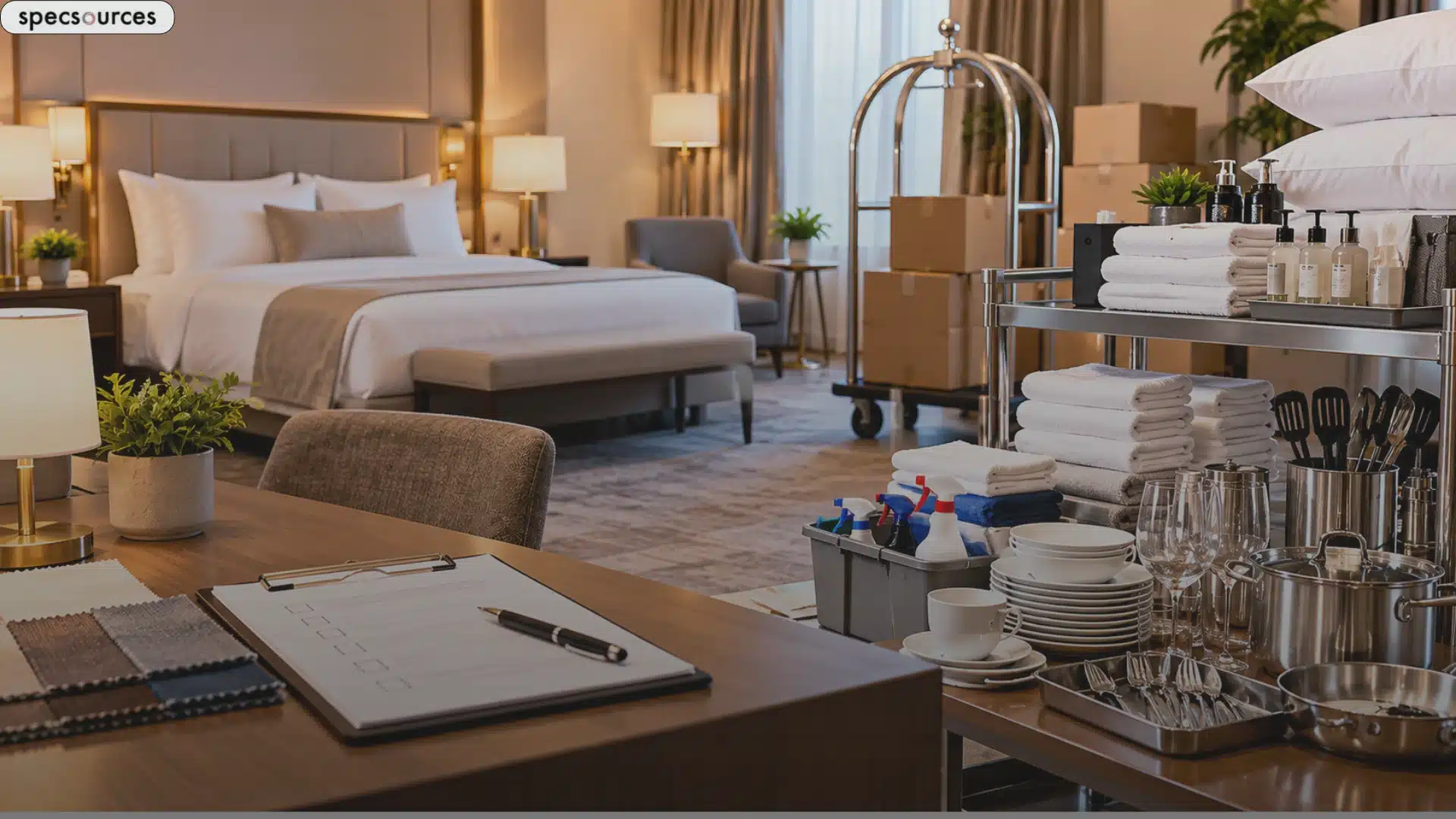
FF&E and OS&E procurement is the process of planning, budgeting, sourcing, purchasing, and delivering the furniture, fixtures, equipment, and operating supplies needed for hotel development, renovation, and daily operations.
Successful hotel procurement requires accurate product specifications, realistic budgets, reliable suppliers, and coordinated delivery schedules. From identifying hotel requirements and selecting vendors to managing purchase orders, controlling costs, tracking inventory, and completing installation, every stage affects project timelines and opening readiness.
Proper procurement planning helps hotels avoid unnecessary expenses, prevent supply shortages, meet quality standards, and prepare every department for smooth operations.
What Is Included in FF&E and OS&E Procurement?
Hotel procurement covers two connected purchasing categories: furniture, fixtures, and equipment (FF&E) and hotel operating supplies and equipment (OS&E). Both support the guest experience, but their purchasing requirements, useful lives, and replenishment needs differ.
What Products Fall Under FF&E and OS&E?
FF&E procurement typically includes guestroom furniture, seating, beds, lighting, desks, and other longer-lasting furnishings. Hotel FF&E may also include movable equipment and hotel furniture accessories.
OS&E procurement covers the everyday items needed for guest services, housekeeping, food preparation, and property operations.
Major categories include:
- Guest room supplies: Hotel linen and towels, bedding and pillows, bathroom amenities, and guest service equipment.
- Housekeeping supplies: Cleaning equipment, laundry equipment and supplies, and consumable supplies.
- Food and beverage equipment: Kitchen utensils and cookware, tableware and dinnerware, glassware and cutlery.
- Front-office supplies: Front desk equipment, reception supplies, and hotel stationery and office supplies.
- Back-of-house supplies: Maintenance tools and supplies, safety and security equipment, and staff uniforms.
- Recreational supplies: Pool, spa, and leisure supplies.
These hotel supplies and equipment must match the property’s room count, service model, and operating requirements.
FF&E vs. OS&E: Summarized Comparison Table
| Procurement factor | FF&E | OS&E |
| Typical products | Furniture, fixtures, major equipment | Linens, amenities, utensils, operating tools |
| Purchasing frequency | Primarily project-based | Initial purchase plus replenishment |
| Budget consideration | Often capital expenditure | Capital or operating expenditure, depending on policy |
| Lead times | Often longer | Vary by category and supplier |
| Main priority | Design, durability, installation | Availability, service quality, inventory |
| Ongoing management | Asset tracking and maintenance | Stock replenishment and replacement |
The distinction between operating supplies vs. fixed assets also influences hotel asset classification, capital expenditure (CapEx), and operating expenditure (OpEx). Classification ultimately depends on accounting policies.
Understanding these differences allows purchasing teams to build a coordinated procurement plan.
How Does the FF&E and OS&E Procurement Process Work?
The OS&E procurement process and FF&E purchasing workflow follow eight main stages. Each requires documented decisions to prevent specification errors, supplier confusion, and unexpected costs.
1. Define Procurement Scope and Requirements
Procurement planning begins by identifying everything the property needs. Teams establish quantities, departmental requirements, approved budgets, and purchasing responsibilities.
A new hotel development may require complete furnishing packages, while a hotel renovation might replace only selected items.
2. Prepare Product Specifications and Quantity Schedules
Every item needs clear product specifications, including dimensions, materials, finishes, manufacturer details, quantities, and intended locations.
For accurate documentation, teams can use standardized FF&E specification sheets to connect design decisions with purchasing requirements.
3. Establish Budgets and Approvals
Procurement managers assign estimated costs, confirm financial limits, and establish approval responsibilities before approaching vendors.
Separate FF&E and OS&E budget schedules help prevent spending in one category from obscuring shortages in another.
4. Source and Evaluate Suppliers
Hotel supply sourcing involves requesting supplier quotations, comparing commercial terms, and confirming manufacturing capabilities.
Effective supplier selection considers pricing, product quality, certifications, warranties, and delivery reliability rather than unit price alone.
5. Issue Purchase Orders
Approved products move into formal purchase orders containing quantities, pricing, specifications, delivery locations, and contractual terms.
Clear documentation reduces purchasing discrepancies and makes later verification easier.
6. Monitor Production and Quality
Purchasing teams track supplier lead times, production milestones, and quality control requirements.
Sample approvals, factory inspections, and documented changes help prevent incorrect products from reaching the property.
7. Coordinate Delivery and Installation
Delivery scheduling must align with site readiness, construction access, receiving capacity, and installation sequences.
Dedicated procurement coordination helps avoid shipments arriving before secure storage or installation areas become available.
8. Verify Deliveries and Complete Handover
Receiving and inspection confirm that delivered products match approved orders, quantities, and condition requirements.
Outstanding defects, missing items, warranties, and operating documentation should be resolved or formally tracked before handover.
These stages form the foundation for a reliable procurement strategy.
How to Plan Hotel Procurement Before Construction or Renovation
Effective hotel procurement strategy starts with the property layout, room mix, operating model, and opening schedule. Purchasing teams should create department-specific schedules before committing to suppliers.
Match Procurement Requirements to Hotel Type
A limited-service hotel may prioritize standardized guestroom packages, while a full-service hotel requires more extensive restaurant, banquet, and housekeeping equipment.
Requirements also differ for luxury hotel supplies, boutique hotel equipment, resort operating supplies, and extended-stay hotel supplies.
Hotel brand standards, service expectations, and room configurations determine what must be purchased.
Assign Clear Procurement Responsibilities
The owner approves budgets, designers establish specifications, procurement managers coordinate purchasing, and department heads verify operating requirements.
For multi-property procurement, standardized specifications and approved vendor lists can reduce repeated work while allowing property-specific adjustments.
Without clear ownership, even a complete purchasing schedule can lead to conflicting approvals.
How to Estimate and Control FF&E and OS&E Procurement Costs
A reliable procurement budget includes product prices and every expense required to receive, install, and operate the items. OS&E cost estimation should also consider opening inventory, replacement stock, and expected consumption.
Build a Complete Hotel Procurement Budget
The hotel opening budget should account for:
- Product quantities and unit cost
- Shipping and freight costs
- Import duties and taxes
- Installation and delivery costs
- Storage, handling, and inspection
- Contingency budget
- Expected replacement costs and lifecycle costs
Bulk purchasing and negotiated bulk purchasing discounts can reduce expenditure, but cost control should prioritize the total procurement cost rather than supplier quotations alone.
Example: Procurement Costs for a 150-Room Hotel
Consider a hypothetical 150-room property purchasing 600 bedside lamps.
| Cost component | Supplier A | Supplier B |
| Product cost | $36,000 | $39,000 |
| Freight and handling | $5,500 | $2,000 |
| Installation | $2,500 | $2,500 |
| Total | $44,000 | $43,500 |
Illustrative figures only, not hotel industry benchmarks.
Supplier B becomes the less expensive option despite a higher initial product price.
The same principle applies to cost per room calculations and OS&E purchasing decisions. Teams should also evaluate product durability and maintenance requirements before approving lower-priced alternatives.
How to Select Reliable Hotel FF&E and OS&E Suppliers
Reliable suppliers should demonstrate commercial hospitality experience, consistent product quality, suitable manufacturing capacity, and realistic delivery commitments.
Vendor management should include sample approvals, compliance reviews, written purchase terms, and documented performance expectations.
Evaluate Quality, Compliance, and Sustainability
Supplier assessments should consider:
- Hotel supply quality standards and commercial-grade equipment
- Health and safety requirements, hygiene standards, and applicable fire safety requirements
- Product warranties and replacement availability
- Sustainable hotel supplies, eco-friendly products, and reusable hotel products
- Energy-efficient equipment, waste reduction, and sustainable procurement practices
A low-cost supplier offering inadequate documentation or uncertain replacement availability can increase long-term project risk.
Once vendors are approved, their production commitments should shape the purchasing timeline.
How to Build a Realistic FF&E and OS&E Procurement Timeline
A realistic procurement timeline works backward from construction milestones, installation access, and the planned opening date.
Long-lead furniture and custom products generally require earlier approval than locally available consumables, although actual timelines depend on supplier capacity and specifications.
When Should Hotels Order FF&E and OS&E?
Hotels should order items according to confirmed supplier lead times, not a single universal purchasing deadline.
An OS&E purchasing schedule should distinguish manufactured equipment, imported products, opening inventory, and frequently available supplies.
For hotel pre-opening procurement, the team should allow time for:
- Sample and design approvals
- Manufacturing and shipping
- Customs and receiving inspections
- Installation and departmental distribution
- Inventory verification and corrective deliveries
An accurate timeline reduces the risk of opening delays caused by missing essentials.
How to Manage Shipping, Inventory, and Installation
Effective logistics management ensures every approved item reaches its intended location in usable condition. Storage and warehousing arrangements should be confirmed before large shipments arrive.
Control Receiving and Departmental Inventory
Hotel inventory management requires teams to reconcile delivery records with purchase orders, record damaged goods, and assign received stock to the appropriate department.
For OS&E inventory, managers should establish:
- Approved stock levels and minimum stock levels
- Par levels, including linen par levels
- Reorder points for recurring supplies
- Inventory tracking and regular inventory audits
- Stock replenishment responsibilities
- Loss prevention and asset tracking procedures
For example, inadequate towel inventory can create stock shortages during peak occupancy, while excessive purchasing creates overstocking and unnecessary storage costs.
Accurate inventory controls connect procurement spending with ongoing hotel operational efficiency.
Common FF&E and OS&E Procurement Risks and How to Prevent Them
The most common purchasing problems involve incomplete specifications, inaccurate quantities, late approvals, unreliable suppliers, and poorly coordinated deliveries.
A practical control framework evaluates each risk before purchasing begins.
| Procurement risk | Potential consequence | Preventive control |
| Incorrect specifications | Unusable products | Approved specification records |
| Inaccurate quantities | Missing or excess inventory | Room-by-room quantity verification |
| Supplier delays | Installation disruption | Milestone tracking and alternative sourcing |
| Budget overruns | Additional project spending | Total-cost comparisons and approval limits |
| Delivery damage | Replacement delays | Receiving inspections and claims records |
For hotel owners managing a Property Improvement Plan, these controls are particularly important because product changes must also satisfy renovation deadlines and brand requirements.
How Procurement Software Improves Purchasing Accuracy
Procurement software helps design and purchasing teams centralize specifications, pricing, vendor details, revisions, and approval records.
Instead of maintaining disconnected spreadsheets, teams can use FF&E specification software to coordinate product information and support purchasing workflows.
For example, SpecSources helps interior designers and procurement professionals manage specification documents, budgets, approvals, vendor information, and purchase orders within a connected platform.
A consistent documentation system is especially valuable when multiple teams must verify procurement readiness.
How to Verify Hotel Opening Readiness
A hotel is procurement-ready when required products have been delivered, inspected, assigned to their locations, and confirmed suitable for operation.
An OS&E procurement checklist should cover guestroom readiness, housekeeping inventory, food-service supplies, safety equipment, and departmental sign-off.
Hotel Pre-Opening Procurement Checklist
- Verify installed FF&E against approved specifications.
- Confirm guest room supplies and housekeeping supplies are available.
- Check kitchen equipment, tableware, and back-of-house supplies.
- Validate opening inventory and replenishment arrangements.
- Resolve damaged, missing, or incorrect products.
- Record outstanding deliveries and assign responsibility.
This final review connects purchasing completion with actual operational readiness.
Key Takeaways for FF&E and OS&E Procurement
- Begin procurement planning alongside hotel design and development.
- Maintain accurate specifications, quantities, and approval records.
- Compare total delivered costs instead of product prices alone.
- Select suppliers based on quality, reliability, and contractual commitments.
- Align procurement schedules with construction and opening milestones.
- Use inventory controls to manage replenishment and avoid shortages.
- Centralize procurement documentation to reduce communication errors.
A coordinated approach improves purchasing accuracy, protects project budgets, and supports a smoother hotel opening.
Frequently Asked Questions About FF&E and OS&E Procurement
What Is Included in FF&E in Hotels?
FF&E in hotels includes furniture, fixtures, and equipment such as beds, sofas, chairs, desks, lighting, mirrors, wardrobes, and lobby furnishings. These products support hotel design, functionality, and guest comfort.
Hotel FF&E procurement also involves selecting materials, documenting specifications, confirming quantities, and coordinating suppliers. Accurate specification records help ensure that purchased products match approved designs and hotel brand standards.
What Is OS&E in the Hotel Industry?
OS&E stands for Operating Supplies and Equipment, covering the products hotels need for daily operations, including linens, towels, toiletries, cleaning supplies, kitchen utensils, tableware, and housekeeping equipment.
Unlike FF&E, many OS&E items require regular replenishment. Effective OS&E procurement ensures each department has sufficient supplies while controlling inventory costs and preventing service interruptions.
What Is the Difference Between FF&E and OS&E Procurement?
FF&E procurement focuses on purchasing longer-lasting furniture, fixtures, and equipment, while OS&E procurement covers operational supplies and equipment used in everyday hotel services.
FF&E purchasing typically requires detailed design approvals and installation coordination. OS&E purchasing places greater emphasis on quantities, inventory availability, replacement frequency, and departmental operating requirements.
What Is the 15-5 Rule in Hotels?
The 15-5 rule is a hotel guest-service guideline that encourages employees to acknowledge guests within 15 feet and greet them verbally within 5 feet. It helps create a welcoming and attentive guest experience.
The rule is associated with hospitality service training, particularly at Marriott properties. It concerns employee behavior and guest interactions rather than FF&E or OS&E purchasing.
What Are the 5 P’s of Procurement?
One practical interpretation of the 5 P’s of procurement is People, Process, Product, Price, and Performance. This is a useful purchasing framework, although there is no single universally standardized list.
In hotel procurement, these five areas help teams assign responsibilities, establish purchasing procedures, verify product requirements, evaluate costs, and monitor supplier performance. Together, they support more consistent purchasing decisions.
How Does the FF&E and OS&E Procurement Process Work?
The hotel procurement process involves defining requirements, preparing specifications, budgeting, sourcing suppliers, approving purchases, tracking deliveries, and inspecting completed orders.
Each stage requires coordination between designers, hotel owners, purchasing teams, and suppliers. Platforms such as SpecSources FF&E procurement software help teams organize specifications, supplier information, budgets, approvals, and purchase order workflows.
How Do Hotels Calculate FF&E and OS&E Procurement Costs?
Hotels calculate procurement costs by multiplying required product quantities by unit prices, then adding freight, taxes, storage, installation, and contingency expenses.
Budget estimates should also consider replacement requirements, supplier lead times, and hotel brand standards. Comparing total landed costs rather than product prices alone gives owners a more realistic view of procurement spending.
How Long Does FF&E and OS&E Procurement Take for a Hotel?
Hotel FF&E and OS&E procurement can take several months, depending on project size, product availability, customization, manufacturing, and shipping requirements. There is no universal procurement timeline.
Custom furniture and imported equipment may require earlier purchasing, while readily available operating supplies can often be ordered closer to opening. Procurement schedules should follow confirmed supplier lead times and construction milestones.
What Standards and Regulations Apply to Hotel FF&E and OS&E Procurement?
Hotel procurement must account for applicable accessibility, fire safety, health, building, and product requirements. Specific obligations depend on the hotel’s location, building type, and the products being purchased.
For U.S. hotels, the 2010 ADA Standards for Accessible Design establish accessibility requirements relevant to hotel facilities and guest rooms. Procurement teams should also verify applicable local building and fire codes before approving products or installations.

 Read more