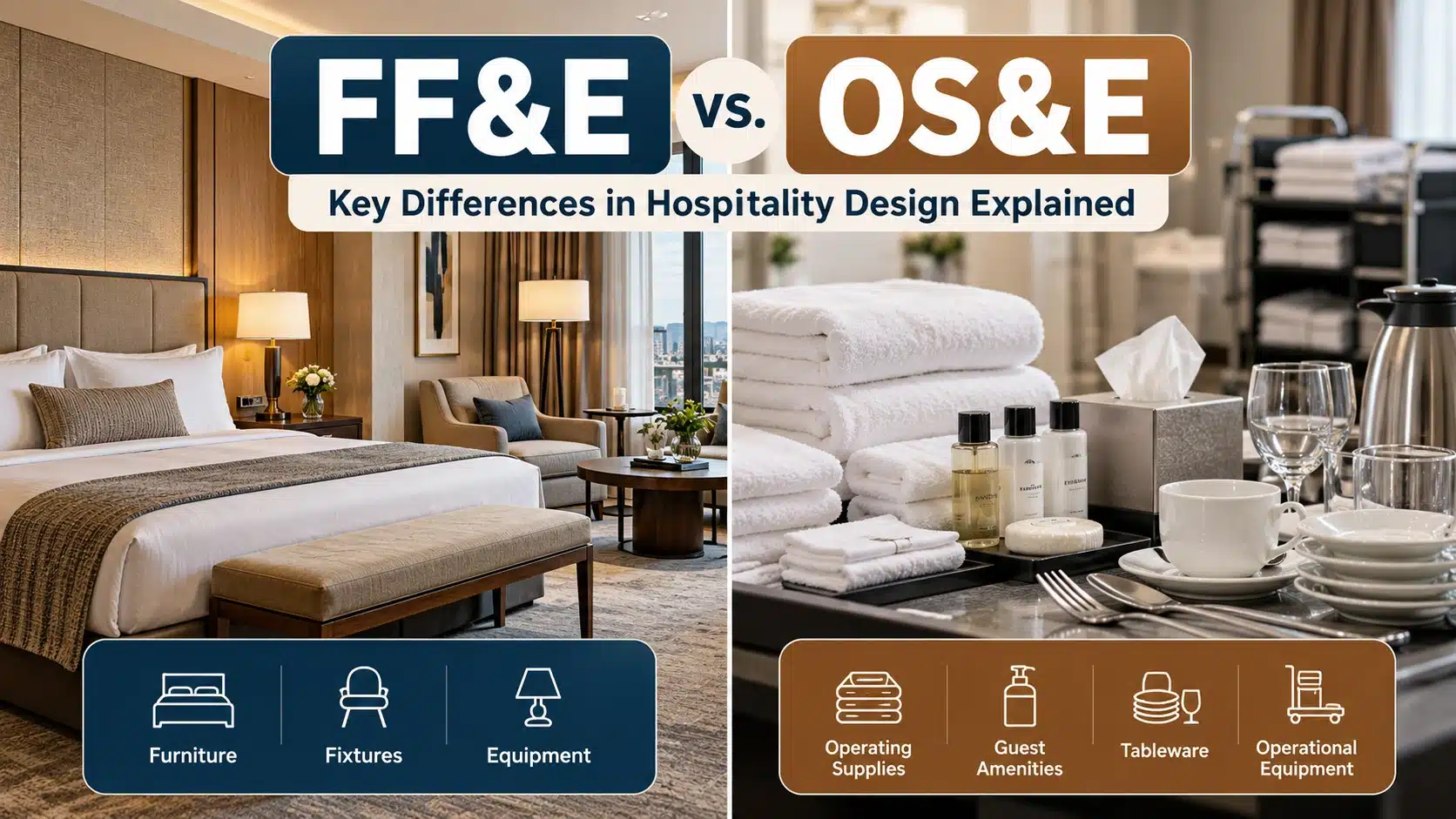
The main difference between FF&E and OS&E in hospitality design is their purpose: FF&E (Furniture, Fixtures & Equipment) includes durable hotel furnishings such as beds, chairs, and lighting, while OS&E (Operating Supplies & Equipment) covers daily operational essentials such as linens, toiletries, and tableware.
Both are essential to hotel design and operations but differ in budgeting, procurement, purchasing timelines, and replacement needs. Proper classification, accurate specifications, and coordinated purchasing help hotel owners, interior designers, and procurement teams control costs, avoid delays, and ensure every space is fully equipped and ready for guests.
What Is the Difference Between FF&E and OS&E in Hospitality?
The primary difference between FF&E and OS&E is how each category supports a hotel. FF&E establishes the physical environment guests use, while OS&E provides the supplies and equipment employees need to deliver hospitality services.
For example, a hotel guestroom may have an installed bed, desk, wardrobe, and television, but it cannot provide a complete guest experience without clean bedding, towels, and essential amenities. Although both categories contribute to the same room, they require different purchasing, inventory, and replacement strategies.
FF&E vs. OS&E: Summarized Comparison Table
| Comparison | FF&E | OS&E |
| Full form | Furniture, Fixtures & Equipment | Operating Supplies & Equipment |
| Primary purpose | Furnish and equip hotel spaces | Support daily hotel operations |
| Common items | Beds, chairs, desks, lighting | Linens, towels, tableware, toiletries |
| Typical lifespan | Several years | Varies from consumable to durable |
| Financial treatment | Often capitalized | Often inventory or operating expenses |
| Procurement focus | Specifications, durability, installation | Quantities, availability, replenishment |
| Purchasing timeline | Often requires longer lead times | Often ordered closer to opening |
| Replacement | Planned refurbishment or asset replacement | Regular replenishment or replacement |
These distinctions guide purchasing decisions, but they are not universal accounting or classification rules. Hotel operators, ownership agreements, brand standards, and capitalization policies can influence how individual items are categorized.
What Is FF&E in Hotel Interior Design?
FF&E includes furniture, fixtures, and equipment specified to furnish hospitality interiors and support their intended use. These items typically represent long-term investments, making product quality, durability, installation requirements, and design consistency important considerations.
What Items Are Included in Hotel FF&E?
Hotel FF&E commonly includes:
- Guestrooms: Beds, headboards, desks, wardrobes, nightstands, and seating.
- Public areas: Lobby sofas, lounge chairs, reception furnishings, and decorative lighting.
- Restaurants: Dining tables, chairs, banquettes, and selected fixed furnishings.
- In-room equipment: Televisions, safes, and minibars, depending on project classification.
How Does FF&E Influence Hotel Design, Guest Experience, and Long-Term Costs?
FF&E determines how a hospitality space looks, feels, and functions. A visually attractive guestroom chair that wears out quickly under frequent use creates additional replacement costs, regardless of its original purchase price.
Interior designers therefore evaluate commercial-grade materials, cleaning requirements, manufacturer warranties, dimensions, and hotel brand standards alongside appearance. Detailed specifications help ensure approved selections remain consistent during purchasing and installation.
What Is OS&E in Hotel Operations?
OS&E consists of the supplies and operational equipment required to deliver hotel services after the property opens. Unlike most FF&E, many OS&E items must be stocked in multiple quantities, regularly cleaned, replaced, or replenished.
What Items Are Included in Hotel OS&E?
Common examples include:
- Guestroom supplies: Sheets, pillowcases, towels, bathrobes, and toiletries.
- Food and beverage: Glassware, cutlery, crockery, and kitchen smallwares.
- Housekeeping: Cleaning tools, laundry supplies, and housekeeping carts.
- Staff operations: Uniforms and selected departmental supplies.
Why Is OS&E Essential for Hotel Opening and Daily Operations?
A hotel needs sufficient OS&E inventory to operate without interruptions. For instance, supplying exactly one set of sheets per bed leaves no replacement available while linen is being washed.
Hotels therefore establish inventory par levels, which define the quantities required to support occupancy, laundry cycles, and operational reserves. These requirements must be calculated before opening rather than after the first guests arrive.
FF&E vs. OS&E Examples Across Different Hotel Areas
The most practical way to distinguish FF&E from OS&E is to examine how individual items are used within a hotel. Their category becomes clearer when considered alongside durability, operational purpose, and replacement requirements.
Guestroom FF&E and OS&E Examples
| Guestroom item | Typical classification |
| Bed frame and headboard | FF&E |
| Nightstand and desk | FF&E |
| Guestroom chair | FF&E |
| Television | FF&E |
| Bedsheets and pillowcases | OS&E |
| Towels and bathrobes | OS&E |
| Guest toiletries | OS&E |
| Drinking glasses | OS&E |
Lobby, Restaurant, and Housekeeping FF&E vs. OS&E
Lobby seating, reception furniture, and restaurant tables usually belong to FF&E because they form part of the property’s durable furnishings.
By comparison, restaurant glassware, serving utensils, cleaning supplies, and housekeeping consumables generally fall under OS&E because they support recurring operational activities.
Which Hotel Items Can Fall Under Either FF&E or OS&E?
Some items cannot be classified reliably by product name alone.
| Item | Classification consideration |
| Minibar | Often FF&E, depending on ownership and project scope |
| Guestroom safe | Usually FF&E, but contracts may classify it differently |
| Kitchen equipment | Major installed equipment may be FF&E or part of a separate kitchen package |
| Decorative accessories | May be FF&E or operational inventory |
| Housekeeping equipment | Varies by equipment type, value, and operator policy |
The key is to establish a project-specific classification schedule rather than assuming every hotel follows identical purchasing categories.
How FF&E and OS&E Affect Hotel Budgets and Procurement Costs
FF&E and OS&E should have clearly defined budget allocations because their purchasing and replacement patterns differ. Combining them without detailed cost categories can conceal missing expenses and make project financial reporting less reliable.
FF&E vs. OS&E: Capital Expenditure and Operating Expense
FF&E is commonly associated with capital expenditure (CapEx) because many items qualify as long-term assets. OS&E frequently includes supplies recognized as inventory or operating expenses, although durable operational equipment can also qualify for capitalization.
Final accounting treatment depends on applicable accounting standards, ownership policies, asset values, and expected useful life. Procurement categories and accounting classifications should therefore be reviewed separately.
Initial Purchasing Costs vs. Maintenance and Replacement Expenses
Consider a hypothetical 100-room hotel purchasing guestroom chairs for $250 each. The initial chair allocation would total $25,000, excluding shipping, taxes, and installation.
Those chairs might remain in service for several years, while towels and toiletries require ongoing replenishment. This difference makes lifecycle cost planning essential for accurately estimating future operating needs.
How to Avoid Budget Gaps When Planning FF&E and OS&E
Develop separate budgets with item-level quantities, estimated unit costs, delivery expenses, and contingency allowances. Account for replacement inventory, freight, storage, and any additional costs that fall outside supplier quotations.
A documented purchasing schedule also helps identify whether essential items are missing before purchase orders are issued.
How FF&E and OS&E Procurement Works in Hospitality Projects
Hotel procurement begins with approved requirements, not purchase orders. FF&E and OS&E purchasing must coordinate design specifications, budgets, suppliers, approvals, and delivery deadlines to ensure the property is equipped for its intended operations.
Who Is Responsible for FF&E and OS&E Specifications and Purchasing?
Interior designers typically establish FF&E selections and specifications, while hotel operators define many OS&E requirements based on service standards and departmental needs.
Procurement teams coordinate quotations, supplier communication, and purchasing documentation. Owners and project managers oversee budgets, approvals, responsibilities, and delivery milestones, depending on the contract structure.
How Do FF&E and OS&E Procurement Timelines Differ?
Custom FF&E often requires earlier purchasing because manufacturing, finish approvals, quality checks, and international shipping can extend lead times.
OS&E may be ordered closer to opening, but supplier selection, quantity planning, and storage arrangements should begin earlier. Large quantities of operational supplies can create significant coordination challenges even when individual items are readily available.
Why Are Accurate FF&E and OS&E Specifications Important?
A complete product specification identifies what must be purchased, where it belongs, and which requirements the supplier must meet. Missing dimensions, incorrect quantities, or outdated finishes can create expensive ordering mistakes.
Structured FF&E schedule software can help design teams connect item records, room assignments, quantities, costs, and approvals throughout the documentation process.
A Five-Decision Framework for Managing FF&E and OS&E
A reliable classification process should answer five questions before an item is approved for purchasing.
| Decision | Action |
| Classification | Determine whether the item belongs to FF&E, OS&E, or another package |
| Financial treatment | Confirm its budget allocation and accounting treatment |
| Specification | Record dimensions, materials, quality, and operational requirements |
| Responsibility | Identify the party responsible for approval and purchasing |
| Lifecycle | Establish delivery timing, maintenance, and replacement needs |
Classify Each Item Based on Its Purpose and Project Requirements
Start with the item’s intended function and the hotel’s purchasing scope. Where classifications overlap, confirm the category with the owner or operator before finalizing procurement documents.
Determine Budget Treatment and Procurement Responsibility
Assign each item to an approved budget and purchasing authority. This prevents duplicate orders and clarifies responsibility when design and operational requirements intersect.
Verify Specifications, Delivery Requirements, and Replacement Needs
Before approval, confirm the selected product, quantity, supplier, delivery location, and expected replacement requirements. Teams can use a structured FF&E schedule template and checklist to identify missing documentation.
Why a Fully Furnished Hotel May Still Be Unprepared to Open
Design completion does not guarantee operational readiness. A hotel can have its furniture installed and guestrooms visually complete while lacking the linens, utensils, supplies, and operational equipment required to serve guests.
How Missing OS&E Creates Operational Problems Before Opening
Imagine a restaurant with installed tables, chairs, and lighting but insufficient tableware for its expected guest capacity. The space is physically complete, yet its service capability remains limited.
This is why OS&E inventory planning must be included in hotel pre-opening preparations.
Common FF&E and OS&E Procurement Mistakes That Delay Hotel Openings
Incomplete inventories, incorrect quantities, unclear purchasing responsibilities, and poorly coordinated deliveries can leave essential items unavailable.
A frequent planning risk is reviewing FF&E installation progress without separately verifying operational inventory and departmental readiness.
How to Check FF&E and OS&E Readiness Before Guest Arrival
Compare delivered items against approved schedules, verify quantities, inspect product condition, and document outstanding orders. Department managers should confirm that operational supplies are sufficient for the planned opening capacity.
How Technology Helps Manage FF&E and OS&E Specifications and Procurement
Digital specification management helps hospitality teams maintain consistent product information across design, approvals, and purchasing. The objective is to reduce documentation errors and improve visibility as project requirements change.
Why Spreadsheets and Disconnected Documents Make Procurement Tracking Difficult
When product specifications, vendor quotations, and approvals are stored separately, teams can unknowingly work from different versions.
An updated furniture finish, for example, may be approved by the designer but never reflected in the purchasing document.
How Centralized Specification and Procurement Software Improves Project Coordination
SpecSources provides design specification software for organizing product details, materials, finishes, vendors, room assignments, and supporting documentation.
Its FF&E procurement software supports connected specification, budget, approval, vendor bid, and purchasing preparation workflows. For BIM-based projects, Revit FF&E integration software helps coordinate furniture and room data with specification records.
These capabilities support FF&E documentation and procurement coordination. Separate OS&E inventory requirements and operator-specific workflows still need to be addressed within the overall project plan.
Key Takeaways: FF&E vs. OS&E in Hospitality Design
- FF&E covers durable hotel furnishings and equipment, while OS&E supports daily services and operations.
- Both categories require different approaches to purchasing, budgeting, and replacement.
- Some equipment classifications vary by project scope, ownership policies, and operator requirements.
- Accurate quantities, specifications, and supplier coordination help reduce procurement mistakes.
- A fully furnished property is not necessarily operationally ready.
- Clear documentation and accountable purchasing processes help hotel teams prepare for successful openings.
Frequently Asked Questions About FF&E and OS&E
What Does FF&E Stand for in Hospitality?
FF&E stands for Furniture, Fixtures & Equipment. It includes durable furniture and equipment used to furnish hotel guestrooms, public spaces, restaurants, and other hospitality areas.
Common examples include beds, headboards, desks, chairs, sofas, televisions, and decorative lighting. These items are typically purchased for long-term use and selected according to hotel design requirements, durability, and brand standards.
What Does OS&E Stand for in Hotels?
OS&E stands for Operating Supplies & Equipment. It includes the supplies and equipment hotels need to maintain daily operations and provide guest services.
Examples include bedsheets, towels, toiletries, glassware, cutlery, housekeeping supplies, and kitchen utensils. Many OS&E items require frequent replenishment, while durable operational equipment may remain in service for several years.
What Is the Main Difference Between FF&E and OS&E?
The main difference between FF&E and OS&E is their function. FF&E provides the durable furnishings and equipment that make hotel spaces functional, while OS&E includes the supplies and equipment needed to operate those spaces and serve guests.
For example, a guestroom bed frame is FF&E, while the bedsheets and pillowcases are OS&E. FF&E generally involves longer-term purchasing decisions, while OS&E often requires ongoing inventory management and replacement.
Are Hotel Linens Considered FF&E or OS&E?
Hotel linens are classified as OS&E because they are operational supplies that require regular washing, inventory management, and replacement.
This category includes bedsheets, pillowcases, towels, bathrobes, and similar textiles. Hotels typically maintain multiple sets to accommodate occupancy, laundry schedules, and replacement needs.
Is Kitchen Equipment Classified as FF&E or OS&E?
Hotel kitchen equipment can be classified as either FF&E or OS&E, depending on the equipment type and the property’s procurement standards.
Large commercial refrigerators, ovens, and installed cooking equipment may be classified as FF&E or included in a separate kitchen equipment package. Smaller operational items such as cookware, utensils, serving trays, and cutlery are generally classified as OS&E.
Are FF&E and OS&E Considered Capital Expenditures?
FF&E is commonly treated as capital expenditure (CapEx), while OS&E frequently includes operating expenses (OpEx) and inventory. However, the actual accounting treatment depends on item value, useful life, and applicable capitalization policies.
For example, hotel furniture purchased for long-term use may qualify as a capital asset, while disposable guest amenities are generally operating expenses. Some durable OS&E equipment may also qualify for capitalization.
Who Is Responsible for FF&E and OS&E Procurement in Hotels?
FF&E and OS&E procurement is typically managed through coordination between hotel owners, interior designers, procurement specialists, project managers, and hotel operators. Responsibilities depend on the project’s contractual arrangements and purchasing requirements.
Interior designers usually specify furniture and finishes, while hotel operators establish operational equipment and supply requirements. Procurement teams manage supplier quotations, purchase orders, deliveries, and purchasing documentation.
How Do Hotels Calculate FF&E and OS&E Budgets?
Hotels calculate FF&E and OS&E budgets by identifying required items, estimating quantities, obtaining supplier prices, and accounting for purchasing and delivery costs. Separate budgets help track initial investments, operational supplies, and future replacement requirements.
For FF&E, estimates typically include furniture, equipment, installation, freight, and contingency allowances. OS&E budgets also consider occupancy capacity, departmental requirements, inventory par levels, opening stock, and ongoing replenishment needs.

 Read more